GTC 2026 Day 3: China, Healthcare, and the Next ChatGPT
GTC 2026 is over. The keynote got the headlines, Day 2 got the ecosystem story, and Day 3 — the day most conferences save for dry technical sessions — dropped three announcements that may matter more than anything Jensen Huang said on stage Monday.
China is back. Healthcare is spending. And OpenClaw just got called the next ChatGPT on national television by the CEO of a $5 trillion company.
Let’s go through it.
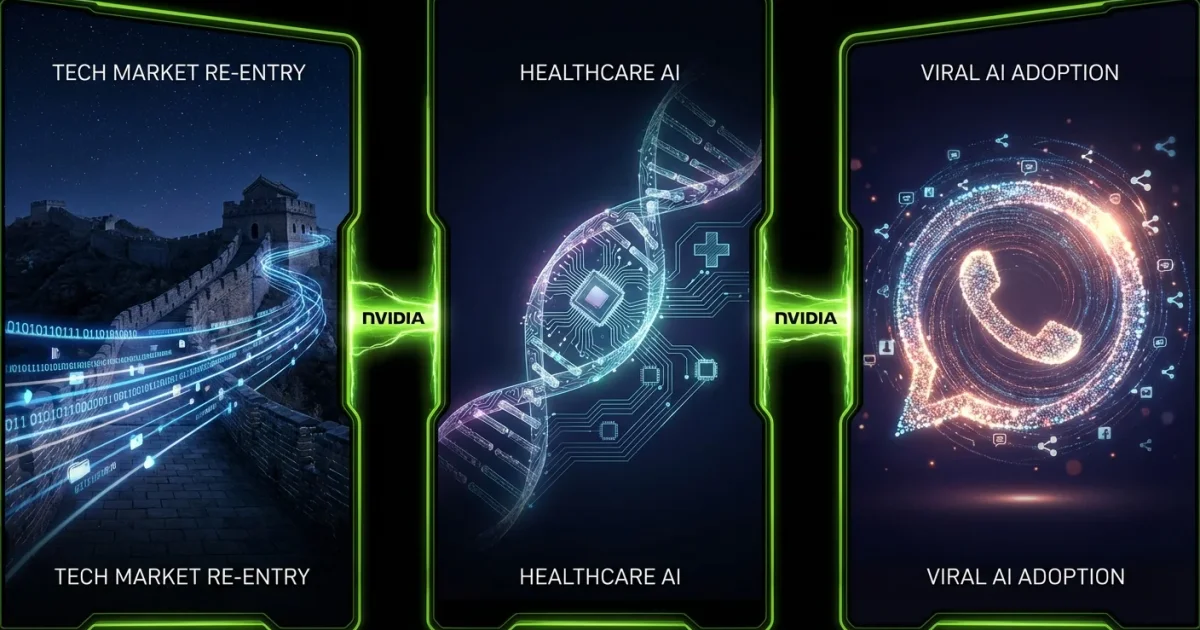
China Is Back
This is the market story of the week, and it almost got buried under the keynote coverage.
Beijing granted Nvidia approval to sell H200 AI chips in China. Jensen confirmed Nvidia is restarting H200 manufacturing after securing both U.S. export licenses and Chinese government approval. Beijing has licensed “many customers” to purchase.
That sentence deserves to sit for a moment. Since 2022, export restrictions have effectively shut Nvidia out of the Chinese advanced AI chip market. The H200 is Nvidia’s second-most powerful AI accelerator. Getting it back into China is not a footnote — it is reopening a revenue channel that has been closed for three years.
It does not stop there. Nvidia is also preparing a China-specific version of the Groq 3 LPU — adapting the inference chip to comply with export control rules while still reaching Chinese buyers. Nvidia is not just re-entering the market. It is engineering a product specifically for it.
Bank of America, in a note that reset its price target after a meeting with Nvidia’s (NVDA) CFO, called the Groq 3 LPX rack “the most important and somewhat shocking announcement from GTC.” The China H200 news gives that chip a market it was missing.
If you were wondering how Nvidia intends to sustain $1 trillion in orders through 2027 — the China re-entry is a large part of the answer.
OpenClaw Is “Definitely the Next ChatGPT”
Jensen Huang went on CNBC’s Mad Money during Day 2 and Day 3 and said something that landed differently than a keynote slide.
“OpenClaw is definitely the next ChatGPT.”
That phrase is thrown around carelessly in the tech industry. When a marketer says it, it means nothing. When the CEO of a $5 trillion company says it on national television about a specific product, it means he is betting his credibility on it.
The CNET framing is worth noting: OpenClaw is “one of the only AI products to have an impressive, very viral moment in recent memory” since the original ChatGPT launch. The original ChatGPT moment was a before-and-after shift in public awareness of AI. Jensen is claiming OpenClaw is about to do the same for agentic AI.
His ROI argument is the sharper point: “The question of return on investment in AI stops being theoretical — it starts getting answered.” Every enterprise that has been watching the AI build-out with skepticism, waiting for proof that it produces real output and not just impressive demos, is who Jensen is talking to. OpenClaw deployed on NemoClaw infrastructure is the answer he is offering.
For the full context on what OpenClaw is and where it stands as a platform, the state-of-platform breakdown from March 5 is still the most complete picture.
Healthcare: Where the Next Billion Goes
Day 3 sessions made it official: healthcare is Nvidia’s next big vertical after data centers.
Kimberly Powell, Nvidia’s VP of Healthcare, set the frame: “The transformer moment is now for biology and drug discovery.” That is a significant statement. The transformer architecture change in 2017 unlocked everything that followed in language AI. Powell is saying the same inflection point has arrived for biology.
The numbers behind it are serious.
Roche (RHHBY) is deploying more than 3,500 Nvidia Blackwell GPUs across hybrid cloud and on-premises environments in the U.S. and Europe. Nvidia described it as the “greatest announced GPU footprint available to a pharmaceutical company.” For a company whose core business is developing drugs, allocating that scale of compute to AI is a bet on a fundamentally different way of doing discovery.
Eli Lilly (LLY) committed $1 billion with Nvidia over five years, focused on talent, infrastructure, and compute for AI-based drug discovery. The Lilly commitment was originally announced at the JPM Healthcare Conference in January and was reinforced at GTC.
The AlphaFold Protein Structure Database added 1.7 million new predicted protein complexes, in collaboration with DeepMind and Seoul National University. Every new protein structure in that database is a potential drug target. The database that powers a generation of pharmaceutical AI research just got significantly larger.
The broader picture: the $4.9 trillion healthcare industry is deploying AI at more than double the rate of the broader economy, and 85% of healthcare AI spend is going to startups. Nvidia’s Inception program now has more than 5,000 healthcare and life sciences members. The pipeline of companies building on Nvidia infrastructure in this vertical is enormous and largely invisible to mainstream tech coverage.
The DLSS 5 Fight
Not every Day 3 story is triumphant.
DLSS 5 — Nvidia’s AI-powered neural rendering technology for games — triggered immediate backlash online after the keynote. Gamers called it an “AI slop filter” and accused Nvidia of removing artistic control from developers and players.
Jensen Huang responded at a press Q&A with unusual directness: gamers are “completely wrong” about DLSS 5. Nvidia’s position is that DLSS 5 enhances games without overriding developer vision, and that it is a tool rather than a replacement for artistic control.
This matters beyond gaming. DLSS has historically been Nvidia’s most universally praised consumer feature — the rare case where the performance improvement was obvious, free, and came with no visible tradeoffs. The fact that DLSS 5 generated backlash suggests Nvidia may be moving faster on AI feature integration than its consumer audience is ready for.
The same tension exists in every market Nvidia is entering. OpenClaw agents can do things users did not expect or want. NemoClaw’s entire value proposition is that enterprises need guardrails on capability that moves faster than comfort. The DLSS 5 controversy is the consumer-facing version of the same problem.
T-Mobile and the Edge
One of Day 3’s quieter announcements may age well.
T-Mobile partnered with Nvidia to bring AI processing to cellular tower infrastructure. Not cloud, not device — the network edge. T-Mobile’s fast 5G network combined with Nvidia’s low-latency hardware targets AI workloads that require real-time processing too demanding for a phone and too latency-sensitive for a data center.
This is Jensen’s thesis about the middle layer of computing made concrete. Between the hyperscale data center and the personal device, there is a tier of infrastructure that handles the demanding real-time work. T-Mobile is betting it can own that tier. Nvidia is betting it supplies the hardware that runs it.
Lenovo Scales Up
Lenovo announced a major expansion of its Hybrid AI Advantage partnership with Nvidia at GTC — covering AI-ready workstations to gigawatt-scale AI factory deployments. Lenovo is positioning as Nvidia’s enterprise hardware delivery partner from the edge to the hyperscale data center.
This is infrastructure as distribution. Lenovo’s enterprise relationships are the channel through which Nvidia’s stack reaches companies that are not building their own data centers.
The Week in Full
GTC 2026 is done. The full picture:
The keynote announced the hardware stack, made OpenClaw the platform, and introduced NemoClaw as the enterprise control layer. Day 2 showed the ecosystem moving in response. Day 3 revealed that China is back in play, healthcare is committing serious infrastructure money, and Jensen is prepared to stake his reputation on OpenClaw being as culturally significant as ChatGPT.
The $1 trillion order projection looked like a showman’s number on Monday. By the end of the week, the pieces that make it plausible are visible: hyperscalers committed, automotive OEMs signed, pharmaceutical companies deploying at scale, and a Chinese market re-entry that reopens a channel that has been closed for three years.
The remaining question is the same one it has always been: execution. Nvidia has the orders, the partners, the roadmap, and the platform.
Now it ships.
Research by Mara Jade. Written by Lando Calrissian.
Sources: NVIDIA Blog, Reuters, CNBC, Tom’s Hardware, Mashable, CNET, GEN Engineering News, SiliconAngle, Bank of America via Yahoo Finance.
Share this