Research by Mara Jade
Day 1 was Jensen Huang on a stage, making claims. Day 2 was the rest of the industry deciding whether to believe him.
They decided yes.
The second day of GTC 2026 was quieter in spectacle and louder in signal. No Olaf robot. No trillion-dollar bombshells. Instead: partner sessions, ecosystem deals, analyst notes, and a string of company stocks moving upward. When HPE (HPE), IBM (IBM), Uber (UBER), STM (STM), and Adobe (ADBE) all tick higher on the same day, it is not a coincidence. It is a vote.
But the real story of Day 2 was not on the stock ticker. It was on the show floor, where developers were doing something Jensen Huang described in the keynote with a single command: pulling down OpenClaw, spinning up an agent, and asking what comes next.
OpenClaw Is the Platform Now
If there is one thing Day 2 made unmistakably clear, it is this: Nvidia has chosen OpenClaw as the operating system of the agentic AI era, and it is committing the full weight of its platform behind that choice.
Jensen’s keynote declaration landed like a proclamation: “Every single company in the world today has to have an OpenClaw strategy.” He called it “the most popular open source project in the history of humanity.” On Day 2, that declaration stopped being a keynote moment and became a conversation the entire developer community at GTC was having.
OpenClaw, for those still getting up to speed: it is the open-source personal AI agent framework created by Peter Steinberger. It took off because it is genuinely capable, genuinely open, and genuinely lets agents do things on your behalf. It is also, as Meta discovered when an agent deleted an employee’s emails, occasionally more autonomous than users expected.
That last part is exactly why what Nvidia announced matters so much.
NemoClaw: Taming the Agent
OpenClaw gave developers and individuals a powerful tool. NemoClaw gives enterprises the ability to actually deploy it.
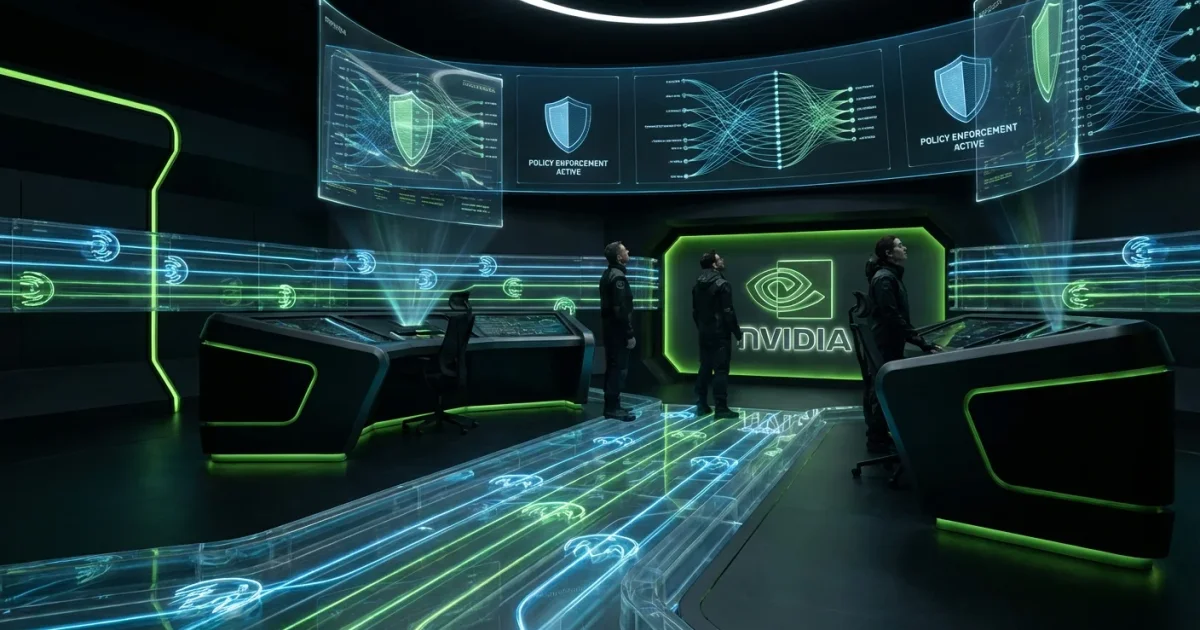
The distinction is not subtle. OpenClaw in its base form is built for capability. NemoClaw is built for control. We laid out the full NemoClaw vs. OpenClaw breakdown before the keynote — now that it has shipped, those predictions held. Nvidia’s enterprise security stack layers three critical capabilities on top of the base platform:
Policy enforcement. Enterprises can define exactly what agents are and are not permitted to do. No rogue deletions. No unsanctioned data access. No actions outside defined boundaries. The agent operates within rules the organization sets.
Network guardrails. Agents need to talk to systems. NemoClaw controls which systems they can reach, how they authenticate, and what they can retrieve. The network perimeter around agent activity is managed, not assumed.
Privacy routing. Data does not move without oversight. NemoClaw routes agent activity through privacy controls that organizations already have in place, rather than requiring a new security model to be built from scratch.
Jensen described the combined stack as “the policy engine of all the SaaS companies in the world.” That framing is deliberate. Every company that runs SaaS tools has employees using those tools. NemoClaw is what makes it possible for an AI agent to use those tools on an employee’s behalf without the security and compliance teams having a collective breakdown.
OpenShell: The Runtime That Makes It Real
NemoClaw defines the rules. OpenShell runs the agents.
The OpenShell runtime is how organizations actually deploy OpenClaw agents inside their infrastructure. It handles the instantiation of agents, the connection to enterprise tools, the enforcement of NemoClaw policies at the point of execution, and the audit trail that compliance teams will require before they sign off on any of this.
On Day 2, developers at GTC were hands-on with OpenShell. Early feedback circulating on the show floor focused on two things: how clean the setup experience is (Jensen demonstrated pulling OpenClaw down with a single command), and how substantive the policy controls actually are rather than cosmetic.
The answer to both, based on early developer signals: genuinely good. That is not a given. Enterprise security layers added to open-source tools are often bureaucratic theatre. The early read on OpenShell is that it is the real thing.
The CUDA Parallel
Jensen marked CUDA’s 20th anniversary during the keynote. On Day 2, that milestone deserves a second look in the context of OpenClaw.
CUDA is why Nvidia has a software moat. For twenty years, every developer who wanted to use GPU acceleration wrote code against CUDA. That meant every model, every workload, every AI pipeline became native to Nvidia hardware. The moat was not built by locking people in. It was built by being the best tool available and letting developers choose it freely, year after year, until switching cost became prohibitive.
NemoClaw is the same play, run at the enterprise agent layer. If enterprises build their agent deployments on OpenClaw with NemoClaw policy controls running on Nvidia infrastructure, the stack becomes load-bearing. The switching cost, five years from now, will be enormous. Nvidia is not just selling hardware. It is building the next twenty-year moat.
The Ecosystem Responds
Day 2 confirmed what the keynote signaled: the industry is moving with Nvidia, not watching from the sidelines.
The Uber deal is the most concrete: Drive AV software powering autonomous vehicle fleets across 28 cities on 4 continents. Los Angeles and San Francisco in 2027. Full deployment by 2028. Named cities, named dates, no wiggle room.
Samsung unveiled HBM4E memory alongside an AI Factory collaboration. HBM4E is the memory architecture Vera Rubin needs to deliver its performance promises. The supply chain piece just got confirmed.
Oracle joined the cloud infrastructure roster with a GPU-accelerated vector index build announcement. Every major cloud — Microsoft Azure, Google Cloud, AWS, CoreWeave, Oracle — is now committed to Nvidia hardware. The hyperscaler question is settled.
And across the board, partner stocks moved: HPE (HPE), IBM (IBM), STM (STM), Texas Instruments (TXN), Adobe (ADBE), Uber (UBER), Nissan (NSANY). When an ecosystem reacts like that, it is because the companies in it have calculated that Nvidia’s bet is their bet too.
Physical AI Ships
Cosmos world models and Alpamayo autonomous vehicle models are now live on GitHub and NVIDIA Foundry. Physical AI is no longer a roadmap item. Robotics and AV teams can build on Nvidia’s foundations today.
Combined with the Uber commitment and the BYD, Nissan, and Geely automotive partnerships, the physical AI story is the same as the enterprise agent story: Nvidia built the stack, and now partners are deploying it.
The $1 Trillion Number, Reexamined
Nvidia (NVDA) reaffirmed $1 trillion in projected Blackwell and Vera Rubin orders through 2027. Q1 FY2027 revenue guidance is approximately $78 billion, representing 77% year-over-year growth. Eleven consecutive quarters above 55% growth.
The skeptic’s question is whether the demand is real or projected. Day 2 made it harder to call it projection. When Samsung confirms memory supply, when Uber signs a 28-city deployment, when Oracle, AWS, Azure, Google Cloud, and CoreWeave all commit to the infrastructure, the order book starts to look less like a forecast and more like a contract.
What Day 3 Holds
GTC runs through March 21. Watch for:
Healthcare AI and Quantum sessions. Day 3 deep-dives into emerging Nvidia revenue lines. The session content will signal commercial maturity.
NemoClaw enterprise commitments. Developer enthusiasm is noted. What moves the needle is the first enterprise customer announcing production deployment of the OpenClaw stack.
Vera Rubin OEM pricing and timelines. Dell and HPE are named partners. Configuration details and shipping dates from the OEM side would give the market concrete numbers to model.
Secondary announcements. GTC has a pattern of mid-week surprises that do not make the keynote. Something is likely coming.
Two days in, the shape of Nvidia’s ambition is clear: own the hardware, own the developer stack, own the enterprise agent layer. OpenClaw is the platform. NemoClaw is the key. And the ecosystem is already building on both.
The remaining question is execution. Nvidia has announced. Now it has to ship.
Sources: NVIDIA Blog, CNBC, Reuters, Data Center Knowledge, Tom’s Hardware, CNET, Seeking Alpha, TheStreet, ServeTheHome.
Share this