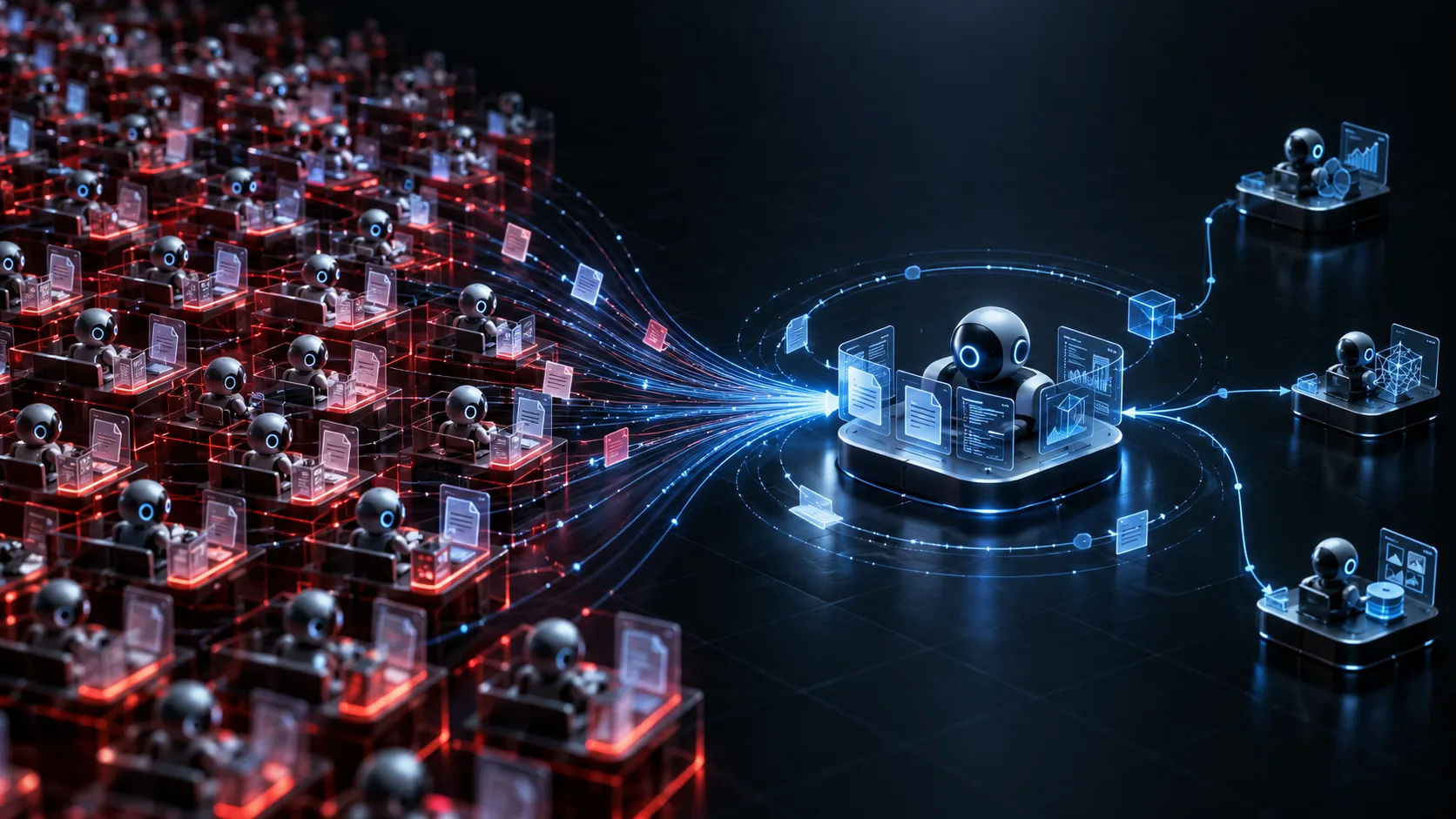
The Agent Org Chart Is Shrinking
For two years, AI agent demos have looked like tiny consulting firms. A planner writes the plan. A researcher gathers links. A coder implements. A critic finds flaws. A manager routes messages between them and announces that the team has finished.
Sometimes it works. Sometimes the manager spends more tokens explaining the task than any worker spends solving it.
The question was never whether multiple agents can cooperate. It was whether each handoff improves the result enough to justify its cost. As models become better at using tools, maintaining state and recovering from mistakes, the answer is changing. The default is moving toward one broadly capable agent that owns an outcome, with specialists called in for a reason. Multi-agent systems are not disappearing. The ceremonial org chart is losing its job.
Why We Built Swarms in the First Place
The early agent workforce was not pure theatre. Older models struggled to hold a long plan, use unfamiliar tools and correct errors across many steps. Splitting a task into researcher, writer and reviewer roles forced structure onto a process that otherwise drifted. Separate contexts could keep one narrow job from overwhelming another.
But the structure had a hidden assumption: that a job title made a model more competent. Often the planner, coder and critic were the same model with different prompts, the same tools and the same incomplete view of the project. The system gained more conversations, not necessarily more independent knowledge.
Anthropic’s guidance on building effective agents recommends starting with simple, composable patterns and adding agentic complexity when simpler approaches fall short. It also documents useful parallel and orchestrator-worker designs. The point is not “never delegate.” It is that complexity should solve an observed problem.
One Owner, a Longer Loop
A comprehensive agent is not an omniscient model. It is a capable operator inside an environment that lets it close a loop: inspect the work, plan, use tools, observe what happened, repair mistakes, verify the result and leave durable state for the next session.
That environment matters as much as the model. Anthropic’s long-running agent work uses preparation, incremental progress and handoff artifacts to keep work coherent across context windows. OpenAI’s long-horizon Codex account likewise emphasizes specifications, milestones, validation and an audit trail. These are not substitutes for intelligence. They are how intelligence survives a long task and a failed attempt.
Independent evidence points in the same direction, with a necessary limit. METR’s task-completion time horizon measures the duration of human-expert tasks that agents can complete at a chosen reliability on mostly self-contained, automatically evaluated tasks. Its results are evidence that agents can handle larger task units. They are not proof that an agent can autonomously perform every messy eight-hour job in a real company. METR explicitly warns that real work is less clean than its task set.
The meaningful shift is not “one model can do everything.” It is that one agent can increasingly remain responsible for a coherent piece of work without outsourcing every intermediate thought to another model.
Every Handoff Spends Context
Delegation sounds cheap until you describe it precisely. A worker needs the goal, the relevant files, constraints, decisions already made, the definition of done and enough authority to act. The owner must package all of that into a message. The worker returns a summary. The owner then decides whether the summary is trustworthy and how to integrate it with the rest of the work.
Something is lost each time. A summary compresses the world from one agent’s point of view. It may omit the constraint that turns a good-looking answer into the wrong answer. Meanwhile, each worker adds model calls, latency, permissions, tracing, retries and potential write conflicts. Those are architectural costs, not a universal benchmark showing that one agent is always cheaper.
Anthropic’s context-engineering guidance treats context as a finite resource. A focused subagent can be valuable precisely because it explores a deep branch without filling the owner’s working context. That is a concrete benefit. Assigning five role titles to the same sequential task is not.
The same principle applies to review. Five agents agreeing on a plausible answer do not establish five independent confirmations if they share the same source, tools and blind spots. A test, a read-back from the system of record or a reviewer following a different evidence path is stronger than an artificial consensus.
The Counterexample: Research Really Can Benefit From a Team
If the story ended at “use one agent,” it would be wrong. Anthropic’s Research system uses a lead researcher and parallel specialists to investigate different branches of a question. Anthropic reports that this architecture outperformed its single-agent baseline by 90.2 percent in an internal research evaluation.
That is not a general law of multi-agent superiority. It is a result for a particular system and task distribution. It does show where parallelism earns its keep: independent searches can proceed at the same time, and the lead can synthesize evidence rather than serially exploring every path.
Other cases are just as legitimate. A security reviewer should not have to inherit the implementer’s assumptions. A worker with a different toolchain or a clean context window may see what the owner missed. A lower-privilege investigator can inspect an untrusted artifact without receiving the owner’s credentials. These agents have distinct information positions or boundaries. They are capabilities, not decorative departments.
OpenAI’s Agents SDK patterns make this distinction explicit. A manager can call specialists as tools while retaining ownership of the user-facing result. A handoff transfers control when the specialist should actually own the conversation. Those are different choices, and the distinction is more useful than asking whether a product is “multi-agent.”
Build Around Accountability, Not Headcount
For builders and enterprises, the new design question is simple: what outcome can one bounded agent own, and what proves it is done?
Start with an owner that has the context, tools and permission to complete a meaningful task. Give it environmental feedback: tests for code, previews for pages, read-backs for data changes, logs for operations. Preserve its decisions and progress outside a single context window. Then add another agent only if it brings parallel work, genuinely independent review, a specialized tool, isolated context or a stricter permission boundary.
Keep some decisions out of model improvisation altogether. Moving money, deleting records and changing production systems require deterministic checks and, where appropriate, human approval. A broad agent should not mean an unbounded agent. The stronger the operator, the more important its audit trail and permission design become.
And measure the result, not the cast size. Did the task pass its acceptance test? How long did it take? How many interventions and retries were needed? What did it cost in model calls and human review? Did the second agent find a real defect that an external verifier would not have caught? A beautiful agent graph with poor outcomes is still poor engineering.
This does not mean comprehensive agents are always cheaper. A frontier model working for hours may cost more than several smaller workers. Parallel research may save time even when it spends more tokens. The economics depend on the task, the harness and the quality bar. The architecture should be chosen from those measurements, not from the number of boxes that looks impressive in a slide deck.
The future is not one super-agent replacing every worker. It is one accountable operator replacing needless handoffs between them. Specialists remain available when they make the work faster, safer or more reliable. The org chart shrinks. The responsibility does not.
Sources: Anthropic on effective agents, long-running harnesses, context engineering and multi-agent research; OpenAI Agents SDK patterns and long-horizon Codex; METR time horizons.
Share this