The Photoshop Panic Started With Skate 3. Then Came REA.
First came the skateboard. Then came the claim that Photoshop was next.
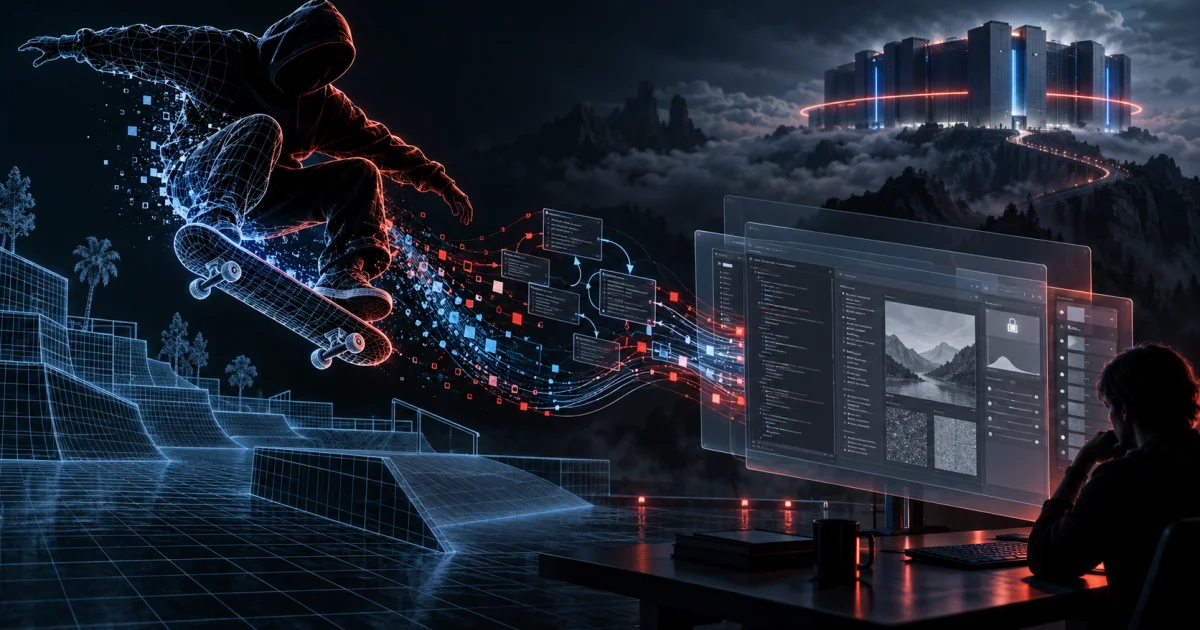
In September, videos of Skate 3 mechanics appearing in other game worlds made a technical story instantly legible. A character could move like a skater inside a shooter. To viewers, it looked as though AI had learned to peel the mechanics out of one game and drop them into another. By October, that visual shorthand had become a much bigger proposition: if agents could do this to games, no piece of software was safe. Adobe could be recreated. Console exclusives could run on PCs. Software itself might be over.
The clips were real demonstrations of interesting work. The conclusion was a leap.
AI did not make reverse engineering trivial. It made an expert workflow conversational, visible and cheaper to operate. That is a serious change. It is not the same as retrieving a program’s original source, reproducing every edge case, or making a commercial product irrelevant overnight.
The Two Years Beneath a Viral Clip
The Skate 3 Rust engine project credits more than two years of earlier reverse-engineering work by dumbad: mapping undocumented formats, animation data and interaction systems. Chasm then used AI assistance to turn that accumulated understanding into a Rust and Bevy implementation. The project’s own account describes a human-and-agent process, not a machine discovering an entire game from a single prompt.
That distinction is easy to lose in a short video. A viewer sees a playable crossover. They do not see the format maps, failed hypotheses, asset handling, engine work or countless checks needed to make the result behave. The mashup made the possibility feel immediate; it did not prove that the hard work had vanished. Know Your Meme’s chronology traces how the Skate 3 clips became a broader game-merging trend.
The viral story was about spectacle. The engineering story was about a lower cost of applying expertise.
What REA Actually Changes
Reverse Engineer Anything, or REA, is an open-source interface for agent-led analysis. It connects an agent to established tools and evidence from binaries, applications and runtime behaviour. Instead of manually navigating every analysis view, a practitioner can ask a bounded question: where is this file format parsed, which function decides this outcome, or what changes when this input is supplied?
The agent can inspect disassembly, decompiler output, strings, call relationships and traces, then assemble a candidate explanation. The human still has to test it. Decompiler pseudocode is an inference from machine code, not the original source tree with its names, comments and design intent restored. An attractive explanation can be wrong.
REA’s DX-Ball reconstruction showcase is more revealing than any one-shot clone claim. It documents a narrow, evidence-led reconstruction with function-level comparisons against the original. The impressive part is not that verification disappeared. It is that an agent helped conduct and document enough of the work to make verification practical.
The new workflow is closer to question, inspect, hypothesise, reproduce, correct than prompt, clone, ship. It can broaden access to compatibility work, security investigation and undocumented legacy systems. It does not repeal the need for a skilled operator or a lawful target.
Photoshop Was Not Decompiled in a Weekend
This is where separate stories were fused into one alarming headline.
PhotoCraft, part of the ArtCraft suite, describes itself as an open-source, clean-room Rust reimplementation of Photoshop-style workflows. Its developer told PetaPixel that AI assisted work on Adobe-style applications. The repository advertises familiar features and PSD support, while also labelling PhotoCraft early alpha.
That is an AI-assisted project making a clean-room compatibility claim. It is not evidence that REA decompiled Photoshop. The public material reviewed for this article does not establish a connection between REA and PhotoCraft, nor does it establish that Adobe’s binary was decompiled to create it.
Nor is a familiar toolbar proof of professional parity. Colour management, plug-ins, PSD edge cases, performance, reliability and years of workflow habits are part of the product. PhotoCraft can be a meaningful alternative in development without being a finished replacement for Creative Cloud.
The real commercial warning is subtler. A small team may now be able to build a recognisable substitute faster, perhaps fast enough to pressure an incumbent before matching every feature. That is different from declaring the incumbent dead.
Software Is More Than the Code You Can Inspect
A downloadable binary is a snapshot of a product. It is not the research that led to it, the experiments that failed, the customer problems still being discovered, or the team that will fix tomorrow’s security issue. A copy of today’s interface does not come with a roadmap.
Professional software also depends on support, documentation, training, accessibility work, integrations, compatibility testing, regulatory obligations and continuous adaptation to new hardware and customer needs. Someone has to maintain those promises when an operating-system update breaks a plug-in or a critical file fails to open. That work is expensive, and it does not end when version one ships.
Security is part of that continuing obligation, and it extends beyond an application’s own code. In our account of the Axios supply-chain attack, a trusted package release channel became the attack path. Customers depend on maintainers and vendors to protect release identities, review dependencies, detect compromises and respond when trust fails. Reproducing an interface does not reproduce that stewardship. The Axios incident does not show that REA causes such attacks; it shows why software cannot be reduced to the code a user can inspect.
Open-source communities, independent developers and new companies can do it. Sometimes they do it better than incumbents. But AI-assisted reconstruction does not fund a support desk, organise a release process or accept accountability for a customer’s lost work. Those require durable people, institutions and business models. Software companies are not rendered obsolete because a portion of their shipped code becomes easier to understand; the ones earning their place are those that keep investing in the product after the imitation catches up.
That is the limit of the “software is over” claim. A product can be copied in outline faster than it can be sustained in depth. Paying for continued R&D and dependable support remains legitimate. Using that work as an excuse to remove ownership and portability is a separate choice.
A PS5 Executable Is More Than CPU Instructions
AnyPS5 makes the technical boundary clearer. The project describes a way to port PS5 executables to Linux and Windows by statically relinking them into target-native executables and supplying clean-room compatibility libraries for PS5 system functions. That is not the same as flawlessly running every PS5 game on a PC.
The PS5 and modern PCs share the x86-64 instruction family. That helps with the CPU. It does not reproduce the console’s operating-system interfaces, graphics behaviour, shaders, audio, input, storage or timing. AnyPS5’s approach still has to replace the platform contract a particular game expects, and then validate it title by title. A boot screen proves far less than a stable, playable game.
It also does not decrypt protected content or supply copyrighted games, firmware or keys. AnyPS5’s own documentation puts lawful access to source binaries on the user. Reverse engineering, decompilation, decryption and circumvention are different acts with different technical and legal boundaries.
This is a more interesting development than the slogan “PS5 games now run natively.” It attacks a specific compatibility problem with a specific architecture. Whether it works broadly depends on the unglamorous interfaces, graphics translations and tests still to be built.
The Answer Could Be More Closed Platforms and More Expensive Software
If client-side behaviour gets cheaper to understand and reproduce, vendors have an obvious response: keep more valuable behaviour off the client. Put rules, models, entitlements, premium data or collaboration state on servers. Tie access to accounts. Stream some applications instead of shipping the executable. Charge for the ongoing service.
That shift predates REA. Faster analysis could strengthen the incentive, but it has not been shown to be the cause of a new industry-wide retreat. The more credible response is selective: closed platforms, stronger account and device binding, more server-side features, and subscriptions where vendors believe control protects their margins. Full streaming is particularly awkward for latency-sensitive games and creative work. A hybrid product is often more plausible than a world in which every desktop application is a video feed.
It could also make software more expensive. Hosted compute, storage, bandwidth, security and support turn a locally executed product into a service with recurring costs. Vendors may recover those costs through higher monthly prices, metered use, premium tiers or reduced features in cheaper plans. Tighter platforms can weaken customer bargaining power and make switching harder. None of this is a guaranteed consequence of REA, and not every price increase would be justified by reverse-engineering risk. The economics depend on competition and on whether customers will accept the trade.
There is a second price for users beyond the bill. More server authority can mean mandatory accounts, weaker offline use, reduced modding and fewer durable copies to preserve. Even a purchased game or tool can become dependent on a service that changes its terms or disappears. On the other hand, cheaper compatibility work can improve interoperability, strengthen open-source alternatives and put downward pressure on prices. Neither outcome follows automatically from the technology.
That is why “software is over” and “PC gaming is dead” are useful as descriptions of the panic, not as forecasts. The open PC market, local performance, ownership demand and the expense of streaming all push the other way.
The question is not whether AI has learned to steal an entire application from a binary. It has not. The question is who benefits when the cost of understanding shipped software falls, and whether the industry’s response gives users more control over their tools or less.
The skateboard clip made that question impossible to ignore. The answer will be decided in compatibility layers, product architecture, licensing and the checkout page.
Sources: Skate 3 Rust engine; REA and its DX-Ball showcase; PhotoCraft and PetaPixel’s report; AnyPS5.
Share this