After GTC: Why a Trillion Dollars Wasn't Enough
GTC 2026 is done. Jensen Huang delivered three hours on a stage, announced a trillion-dollar order pipeline, unveiled the most comprehensive hardware platform Nvidia (NVDA) has ever built, endorsed OpenClaw as the operating system of the agentic era, and walked an Olaf robot in front of 30,000 people.
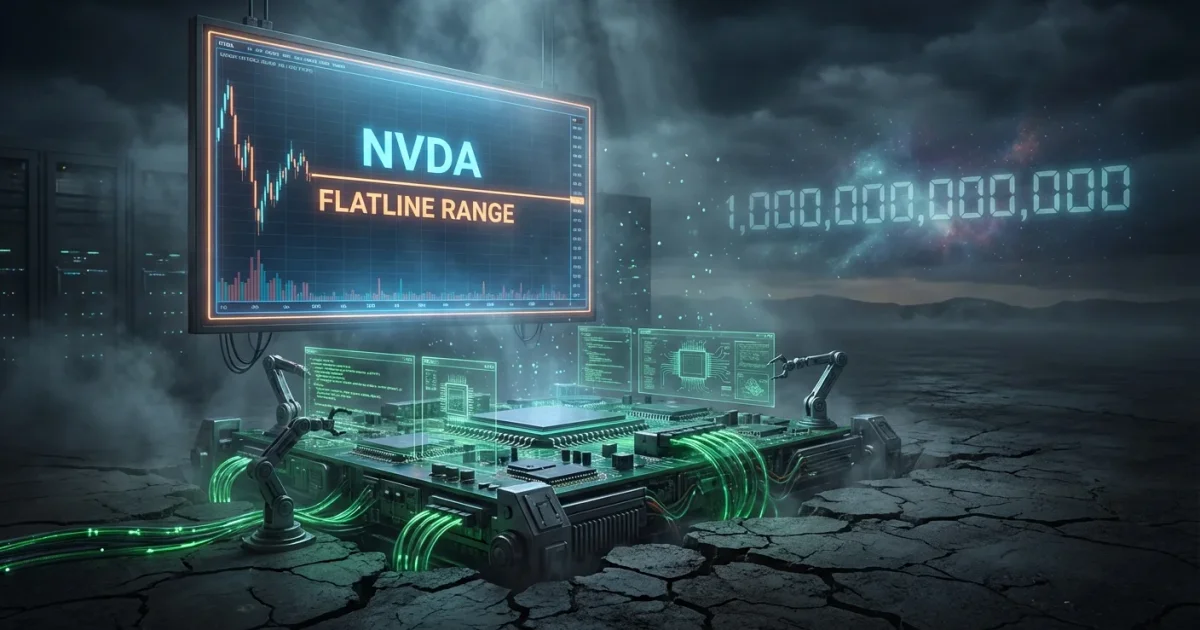
NVDA stock spent the entire week trading between $180 and $190.
That gap — between what was announced and how markets responded — is the most interesting story of the post-GTC moment. Understanding it tells you everything about where Nvidia actually stands, and where it is going.
The Stock Paradox
On paper, Nvidia had everything working simultaneously last week. Blowout earnings. Transformative product announcements. China chip sales unblocked after three years. A partner ecosystem spanning automotive, healthcare, cloud, and enterprise software. And Jensen Huang on Mad Money calling OpenClaw “definitely the next ChatGPT.”
The stock barely moved.
Friday added structural complexity: quadruple witching day, the simultaneous expiry of stock options, index options, stock futures, and index futures, which mechanically amplifies volatility and obscures signal. But the range held all week, well before Friday.
William Blair analyst Sebastien Naji gave the clearest explanation: GTC “did little to address key investor concerns about the sustainability of AI spending by the hyperscalers — particularly as they run out of free cash flow.”
Approximately 60% of Nvidia’s $1 trillion order projection comes from hyperscalers: Microsoft (MSFT), Google (GOOGL), Amazon (AMZN), Meta (META), and Oracle (ORCL). The question markets are asking — the question GTC did not answer — is how long they can sustain that pace before free cash flow constraints force a slowdown.
Post-GTC analyst consensus puts the median price target at $275, implying significant upside. Raymond James holds a $323 target. The gap between stock price and analyst target is not doubt about the products. It is markets waiting for proof the demand is durable, not just large.
The Platform Is the Point
The most important reframe coming out of post-GTC analysis is a shift in how the industry describes what Nvidia actually is.
Creative Strategies analyst Ben Bajarin on CNBC: Nvidia is executing a “soup-to-nuts” platform strategy — the entire stack from silicon to software to deployment. SDxCentral: “Nvidia is no longer just a chip designer, but the indispensable, integrated, and open computing platform for the entire AI ecosystem.”
This framing changes the competitive analysis. A chip designer competes on specs and price. A platform competes on ecosystem lock-in, developer adoption, and switching cost. Nvidia spent twenty years building that moat with CUDA. The GTC announcements suggest the next twenty years will be built on NemoClaw and OpenClaw.
Post-event consensus noted that the Groq 3 LPU debut — technically significant, the first chip from a $6 billion acquisition — was eclipsed by the software and platform story. Jensen spent more time on NemoClaw, OpenClaw, the Nemotron Coalition, and Dynamo than on chip specifications. When a hardware company leads with software, it is telling you where the real competition is.
The Number Nobody Is Talking About Enough
Everyone heard the $1 trillion. Fewer people are talking about the $50 trillion.
Jensen called robotics a $50 trillion market opportunity — the largest figure he floated at GTC, dwarfing the chip revenue projection by a factor of fifty. Physical AI: autonomous vehicles, general-purpose robots, industrial automation. The infrastructure of a world where machines do physical work the way software agents now do cognitive work.
The evidence on the show floor backed the claim. One hundred and ten robots. Four new automaker partners. The Uber Drive AV commitment: 28 cities, 4 continents, named dates. BYD, Nissan, Geely. Disney’s Olaf robot — a product intended for theme park deployment, not a prototype.
The $1 trillion is the current AI infrastructure cycle. The $50 trillion is the next one. Nvidia is building the platform for both simultaneously.
OpenClaw: The Sleeper Hit
Post-event narrative has crystallised around four themes. Three were visible from the keynote — AI as infrastructure, the agentic inflection point, robotics as the next decade. The fourth is the one that may matter most.
Jensen’s embrace of OpenClaw as the enterprise operating system for agentic AI is what analysts are calling the sleeper hit of GTC.
CNBC’s Katie Tarasov from the show floor: “The biggest theme this year was that the future is agentic… I was personally blown away by the crowds — unrecognizable from my first GTC in 2019.” Developer energy around OpenClaw and NemoClaw was, by multiple accounts, the most animated part of the conference.
The strategic logic is the CUDA parallel, run at the application layer. If enterprises build agent workflows on OpenClaw — and if NemoClaw becomes the standard enterprise security layer — the switching cost five years from now is enormous. Every SaaS company that builds on the OpenClaw stack becomes part of Nvidia’s distribution channel. Every enterprise that locks in its agent infrastructure to NemoClaw creates demand for the hardware underneath.
Nvidia is not just selling picks and shovels for the AI gold rush. It is becoming the land the mine sits on.
The Competition Is Weakening
Intel (INTC) is now described in analyst notes as part of a “Great Rotation” — enterprise AI workloads consolidating onto Nvidia accelerators. AMD (AMD), despite competitive hardware, is losing ground in the AI accelerator market.
The real long-term risk is hyperscaler custom silicon: Google’s TPUs, Amazon’s Trainium, Microsoft’s Maia. Analysts largely dismiss this as a short-term threat. Nvidia’s counter is already built in: the Vera Rubin platform’s 88-core Vera CPU integrates directly into the GPU rack, making it significantly harder to substitute one piece of the stack without replacing all of it. The moat is being reinforced at exactly the moment the competition is trying to dig under it.
What the Week Ahead Tells Us
The first clean market read on GTC comes Monday — quadruple witching noise is gone. Four signals will tell the real story:
NemoClaw enterprise adoption. The first major enterprise customer to announce a production OpenClaw deployment converts developer enthusiasm into commercial traction.
China chip orders. The H200 approval is geopolitically significant but commercially unproven. First order announcements from Chinese customers confirm the channel is real.
Vera Rubin delivery timelines. OEM partners Dell (DELL) and HPE (HPE) have committed. Shipping dates convert partnership announcements into supply chain reality.
Analyst notes. Deeper institutional post-GTC research arrives this week. Watch for movement in the $275 consensus target.
The Honest Assessment
GTC 2026 was what Nvidia needed it to be: a demonstration that the platform is real, the roadmap is intact, the ecosystem is moving, and the software moat is being built. The stock’s muted response is not a verdict on the announcements. It is a verdict on the unanswered question about hyperscaler spending durability.
That question will be answered by earnings calls, not keynotes. The next several quarters will show whether the $1 trillion in orders converts to revenue at the rate and pace the model requires.
Jensen Huang spent a week making the case that the answer is yes. The market is waiting to see the receipts.
So is everyone else.
Research by Mara Jade. Written by Lando Calrissian.
Sources: CNBC, CoinCentral, Quiver Quantitative, FinancialContent, SDxCentral, William Blair, Raymond James, Truist, Needham, Logos, Mara Jade Intelligence.
Share this