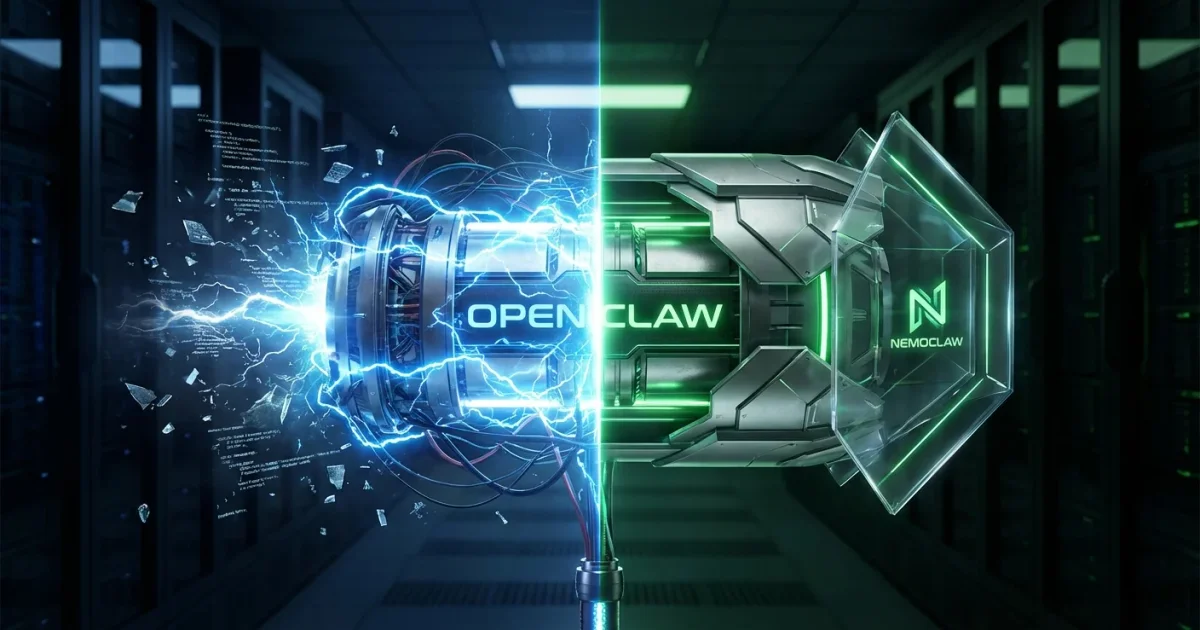
NemoClaw Is Not the New OpenClaw. It's the Suit of Armour Around It.
Since Jensen Huang walked off stage at GTC, a version of the same question has been appearing in Slack channels, LinkedIn comments, and IT strategy meetings: Is NemoClaw replacing OpenClaw?
The answer is no. And understanding why matters more than the question itself.
The Confusion Is Understandable
Nvidia unveiled NemoClaw at GTC 2026 and in the same keynote Jensen called OpenClaw the operating system of the agentic era, compared it to Linux and Kubernetes, and said every company in the world needs an OpenClaw strategy. Two products, one stage, one CEO doing most of the talking. The narrative blur was inevitable.
But these are not competing products. They are not alternatives. NemoClaw is built on top of OpenClaw. You cannot have one without the other. What Nvidia built is the enterprise wrapper around something that already exists and already has 265,000 GitHub stars and a community that was deploying it in production long before Jensen said a word about it.
To understand why that matters, you need to understand what OpenClaw actually is — and what its real problem has always been.
What OpenClaw Actually Is
OpenClaw is a self-hosted AI gateway. A Node.js daemon that connects large language models — Claude, GPT, Gemini, and others — to the messaging apps you already use: Telegram, WhatsApp, Slack, Discord, Signal, iMessage, and a dozen more. You run it on your own machine. Your AI agent lives there, persistently, with tools: browser control, file access, code execution, multi-agent spawning, and an expanding skills ecosystem called ClawHub.
It was created by Austrian developer Peter Steinberger. It started as a WhatsApp gateway, became Clawd, then briefly Moltbot after an Anthropic trademark concern, and finally launched as OpenClaw on January 30, 2026. It passed React on GitHub stars in approximately 60 days. The r/openclaw subreddit pulls 155,000 weekly visitors. A pull request arrives roughly every two minutes.
The ceiling on what people are doing with it is extraordinary. Tesco grocery autopilots. Multi-agent orchestration with a dozen workers. iOS apps deployed to TestFlight without opening a laptop. Overnight startup products on a six-dollar VPS. Emergent agent behaviour — briefings no one programmed, appearing because the context was right.
This is the thing Jensen called the next ChatGPT. It earned that comparison on its own before Nvidia touched it.
Now for the part nobody in the keynote dwelled on.
OpenClaw’s Real Problem
OpenClaw is powerful and it is insecure by design.
Within weeks of launch, security researchers found more than 30,000 OpenClaw instances exposed on the public internet — leaking API keys, conversation histories, and credentials. A critical vulnerability (CVE-2026-25253, CVSS score 8.8) allowed one-click remote code execution via a malicious website. Koi Security and Cisco confirmed that 12% of skills on the ClawHub marketplace were malicious — keyloggers and information stealers packaged as useful tools. The Moltbook breach exposed 35,000 user emails and 1.5 million agent API tokens.
Microsoft Security published guidance treating OpenClaw as untrusted code execution with persistent credentials. CrowdStrike, Cisco, several banks, and multiple governments issued internal restrictions. Gartner described it as a “dangerous preview of agentic AI — high utility but insecure by default.”
The architecture has a fundamental structural issue: credentials can enter the LLM context. Your Bearer tokens, your API keys, the credentials your agent uses to do real things in the real world — they can end up in a prompt sent to an external model provider. That means they can end up in a provider’s database. That means anyone with access to that database has potential access to your credentials.
Illia Polosukhin, co-author of the original transformer paper, called it out directly and announced a Rust rewrite specifically to solve it. The architecture risk is acknowledged at the highest level of the field.
OpenClaw knows this. The community knows this. It is not a bug that will be patched. It is a consequence of how the system was designed for speed and openness rather than enterprise governance. That is not a criticism — it is what made it grow at the pace it did. But it is why 30,000 instances are sitting exposed on the internet right now.
This is the problem NemoClaw was built to solve.
What NemoClaw Actually Is
NemoClaw is not a product. It is a stack.
At the base: OpenClaw, unchanged. The same runtime, the same skills, the same community ecosystem.
Around it: five layers of security infrastructure built by Nvidia, in partnership with Peter Steinberger himself, alongside CrowdStrike, Cisco, and Microsoft Security. The security layer is called OpenShell, and it is the heart of what makes NemoClaw different.
On top: Nemotron, Nvidia’s own local language models, running on-device with no cloud dependency. And a Privacy Router that acts as a traffic cop between your agents and the outside world.
Here is what each layer actually does.
The Five Layers of OpenShell
Layer 1 — Kernel-Level Sandboxing. Agent execution is isolated at the kernel level. The agent cannot reach outside its defined permissions. This addresses the class of vulnerabilities that CVE-2026-25253 exploited — a malicious webpage can no longer hijack your agent and redirect its actions.
Layer 2 — Policy-Based Guardrails. Your IT department defines what agents are allowed to do. OpenShell enforces those policies at runtime and blocks anything outside scope. This is the control plane that makes enterprise deployment governable — for the first time, you can answer the question “what is this agent allowed to do?” with something more precise than “whatever the LLM decides.”
Layer 3 — Network Controls. OpenShell enforces which endpoints agents can reach. It blocks exfiltration paths that do not flow through the privacy router. The silent data leakage that characterised early OpenClaw deployments — credentials and sensitive content flowing to unexpected destinations — is stopped at the network layer.
Layer 4 — Privacy Router. This is the traffic cop between your agent and everything outside your environment. Every communication with an external system, including cloud AI models, passes through the router. If the agent attempts to send sensitive data somewhere unauthorised, the router blocks it. This makes hybrid deployment — using powerful frontier models for reasoning without raw data leaving your environment — actually safe rather than aspirationally safe.
Layer 5 — Local Inference via Nemotron. Nvidia’s own models run on-device: on RTX PCs, RTX PRO workstations, DGX Spark, DGX Station. Sensitive data never hits a cloud API unless it is explicitly routed through the privacy router with appropriate controls. This solves data sovereignty for regulated industries — healthcare, finance, legal, government — where data leaving the environment is not a preference but a compliance requirement.
The security ecosystem built around this is substantial. CrowdStrike’s Secure-by-Design AI Blueprint is embedded. Cisco’s AI Defense is integrated. Microsoft Security has reported a 160x improvement in finding and mitigating AI-based attacks when running in this configuration.
Nvidia’s Strategic Play
NemoClaw is free and open source.
That is not an accident. It is the Red Hat Linux playbook run at the platform layer: give the operating system away, sell the servers and enterprise support it runs best on. Nvidia’s Nemotron models are optimised for Nvidia hardware and NIM (Nvidia Inference Microservices). OpenShell performs best on Nvidia GPUs. The stack is hardware-agnostic by design — Nvidia was explicit about this — but the performance advantage on Nvidia silicon is built in.
The CUDA parallel is instructive. Nvidia spent twenty years making CUDA the default way to program GPU compute. Developers wrote to CUDA. Applications were built on CUDA. Switching away from CUDA became progressively more expensive because the ecosystem sat on top of it. Today, every AI training and inference workload that wants to run on a GPU runs on CUDA, and by extension on Nvidia hardware.
NemoClaw is the attempt to do the same thing at the enterprise agent layer. If enterprises build their agentic workflows on OpenClaw governed by OpenShell, and if NemoClaw becomes the standard security framework for enterprise agent deployment, the switching cost five years from now is enormous. Every SaaS company that builds on the OpenClaw stack becomes part of Nvidia’s distribution channel. Every enterprise that standardises on NemoClaw creates demand for the Vera Rubin hardware underneath it.
Jensen said every company needs an OpenClaw strategy the same way they needed a Linux strategy, an HTTP strategy, a Kubernetes strategy. He meant it. And Nvidia intends to be what Red Hat was to Linux — the enterprise layer that makes the open-source revolution safe enough to bet your business on.
What NemoClaw Does Not Solve
NemoClaw is in alpha. Nvidia said so explicitly. Expect rough edges.
But beyond the alpha status, three gaps matter for enterprise decision-makers.
Audit trails and compliance. OpenShell controls what agents do in real time. It does not yet answer the question every auditor will ask: prove to me what this agent did, why it did it, and with what data. Banking regulators, healthcare compliance officers, and legal teams need tamper-proof logs that can be produced in a discovery request. That layer is not in the current stack.
Cross-agent governance. Enterprise AI deployments are not single agents. They are teams of agents — orchestrators, workers, specialists — communicating and handing off tasks. How OpenShell handles policy enforcement across multi-agent workflows, and how you audit cross-agent communication, remains an open question.
Regulatory certification. Data governance and regulatory compliance are not the same as data security. OpenShell does not yet tell you how to prove to an auditor that your agent met GDPR, HIPAA, or SOX requirements. The infrastructure for trustworthy data handling is there. The certification framework is not.
These are not reasons to ignore NemoClaw. They are reasons to understand what it is and what it is not, and to plan accordingly.
Who Needs What
If you are a developer or a power user running OpenClaw on your own machine for your own purposes — continue. OpenClaw is extraordinary for what it does and the community building on it is producing genuinely remarkable things. NemoClaw adds complexity and infrastructure you do not need.
If you are an IT leader, a CTO, or a CISO at a company where agents are either already running unofficially or are on your near-term roadmap — NemoClaw is the answer to the question you should already be asking. Shadow AI is not a future concern. It is in your organisation right now. There are OpenClaw instances running on employee machines that your security team has not seen. The 30,000 exposed public instances are the visible edge of a much larger phenomenon.
NemoClaw does not prevent your people from using OpenClaw. It gives you the controls to govern how they use it, what it can access, where data goes, and what happens when something goes wrong.
OpenClaw is the engine. NemoClaw is the suit of armour.
You do not choose between them. You decide whether your deployment is ready to put the armour on.
Sources: NVIDIA Official Press Release, TechCrunch, ZDNet, CIO, Kiteworks, Mara Jade Intelligence (OpenClaw State of the Platform, March 5, 2026; Jensen’s OpenClaw Mandate and OpenShell Deep Dive, March 18, 2026).
Share this